
This State-corporate 'cooperation' didn't begin with the arrival of the Modi government.
Many of the big licences, contracts, and even environmental clearances for the Adani group had come in the UPA's time, points out Shekhar Gupta.

'Markets are factoring in a good show by India Inc in Q2.'

Expressing concern over revelations by whistleblower Edward Snowden alleging that the NSA spied on Chinese leaders and businesses, China on Monday demanded that the US explain the facts and stop surveillance activities.
While the government has not barred procurement of equipment from Chinese companies, the process to amend the general financial rules (GFR) 2017 has started. This will impose restrictions on bidders in public procurement from countries that share a land border with India, reports Megha Manchanda.

Equity indices staged a pullback on Tuesday after three days of declines as investors scooped up IT, metal and consumption stocks amid a largely positive trend overseas. A recovery in the rupee added to the momentum, traders said. Overcoming a wobbly start, the 30-share BSE Sensex climbed 274.12 points or 0.45 per cent to settle at 61,418.96.
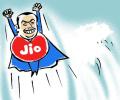
Reliance Jio's aggressive target to reach 100 million households through the launch of the 5G fixed wireless access (FWA) could make it one of the world's largest players in this space. But this also marks a change from its earlier strategy of offering fibre-to-the home (FTTH) broadband to households. Despite its best efforts, in two years Jio has been able to connect only 7 million households with FTTH, as permission for right of way for the last mile became a major impediment and the process of laying ducts for the roll-out was slow and cumbersome.

10 non-bank and non-finance stocks from the BSE500 Index universe that offer an optimal blend of low valuation, reasonably robust revenue and earnings growth in recent quarters, a strong balance sheet, and most importantly, positive cash flow from their operations.

The phone works on Time Division Synchronous Code Division Multiple Access (TD-SCDMA).

Discussing the prospect of more reform earlier this month, telecom minister Ashwini Vaishnaw announced a delay in the 5G spectrum auction. India's telecom sector regulation has to be benchmarked with the global best, he said. It's another matter that many countries have either introduced or are about to roll out 5G services that will enable cutting-edge tech in diverse areas. For India, too, it will mean a lot for healthcare, robotics and unleashing a new chapter in Digital India perhaps.
Emphasising on greater transparency at the World Trade Organisation, both India and China have said no last minute surprises should be sprung on negotiators.

Is self-reliance the right approach in a mega-buck game, or better to be part of a network? asks T N Ninan.

Most Indian IT firms work as system integrators for Huawei and though the exposure is very less as of now, the potential is more due to 5G roll out. As pressure to keep the Chinese firm out of the 5G network grows, other global firms, including Japan's NEC, South Korea's Samsung, Finland's Nokia and Sweden's Ericssion are increasing their investments to grab more market share in the telecom sector.

Dispelling the notion that India-China are rivals, Bambawale also said there is no "anti-China mentality" in India.

Recently, Prime Minister Narendra Modi met over 40 CEOs across broad swathes of industry, ranging from makers of mobile devices, auto components, food products to telecom networking equipment and pharmaceuticals. The agenda: To discuss how to make India an integral part of the global supply chain. The focus of the discussion would be the much touted yet not so well understood production-linked incentive scheme (PLI), the centrepiece of the government's drive to massively boost the manufacturing sector. To do so, the government has created a war chest of over Rs 197,000 crore to be paid out as incentives to over 14 industries in five years. There are three objectives to the scheme, two explicitly stated, one implied.

Both sides to enhance cooperation in combating international terrorism.
Despite its BPO edge of skilled manpower and low labour cost, India's 'Advantage BPO' position may not be sustainable in the long run as nations like China, the Philippines and Mexico are fast catching up, a ASSOCHAM-IDC survey says.

BSE Bankex and Telecom indices led the fall.

The Department of Telecom on Tuesday approved applications of telecom companies -- Reliance Jio, Bharti Airtel, Vodafone Idea and MTNL -- for conducting 5G trials but none of them will be using technologies of Chinese entities. The list of telecom gear makers approved for trials include Ericsson, Nokia, Samsung, C-DOT and Reliance Jio's indigenously developed technologies.

It came as a surprise to all stakeholders - competing telecom companies (telcos), most analysts and even the government's internal projections on revenues from the 5G auctions. Reliance Jio disrupted all calculations by paying a stiff Rs 40,000 crore to buy 10 MHz of spectrum in the 700-MHz band, globally considered a key band for efficient 5G service coverage, along with the default 3.5 GHz band and the ultra-high speed and low-latency millimetre band of 26 GHz band. So what made Jio pay almost 45 per cent of its total spend in this auction for the 700 MHz band - much more than what it rustled up even for the 3.5 GHz band?

RIL has been talking to groups including Gionee, Huawei and Xiaomi

Billionaire Mukesh Ambani's Reliance Industries Ltd climbed two spots to No. 53 on Forbes' latest Global 2000 list of public companies worldwide. Forbes Global 2000 ranks the largest companies in the world using four metrics: sales, profits, assets and market value, Forbes said releasing the 2022 ranking of the world's top 2,000 companies. Reliance is the top-ranked Indian firm on the list, followed by State Bank of India at No. 105, HDFC Bank at No. 153 and ICICI Bank at No. 204.

Equity benchmarks began the week on a downbeat note on Monday, weighed by heavy selling in market heavyweight Reliance Industries and persisting weakness in global bourses. The rupee plunged to its lifetime low against the US dollar amid unabated foreign fund outflows, underscoring the risk-off sentiment prevailing globally as central banks embark on policy tightening to tame soaring inflation. Slipping for the second straight session, the 30-share BSE Sensex shed 364.91 points or 0.67 per cent to close at 54,470.67.

Around 83 per cent people in a survey in India shared that 5G is one of the factors they consider while buying a new phone and nearly three in every five existing premium smartphone users are looking to upgrade their device to the next generation technology, according to a report released by Cybermedia Research. According to the survey, 81 per cent respondents prefer Oppo for 5G smartphone and 79 per cent opted for Samsung. The global survey conducted in India, China and West Europe found that 5G users, where the service is available, have experienced better video calls, faster downloads and ability to stream ultra high definition videos and satisfaction level from 5G services is around 80 per cent.

India is looking to develop alternative export markets for tea such as Iraq, Saudi Arabia, the US, Japan and Tunisia in view of the Russian invasion of Ukraine, people aware of the matter said. Meetings are being held with buyers in some of these countries in virtual mode, with the help of diplomatic missions located there. Similar meetings for the remaining countries have also been planned.

Equity investors have become poorer by more than Rs 18.74 lakh crore as the market continued to remain bearish for the fifth session on the trot on Thursday. The 30-share BSE Sensex tumbled 1,158.08 points or 2.14 per cent to end below the 53,000-level at 52,930.31 points on Thursday. Markets have been falling for five straight sessions and the BSE benchmark has tumbled 2,771.92 points or 4.97 per cent during this period.

The government may tweak customs duties in the Budget next week on several goods, including furniture raw materials, copper scrap, certain chemicals, telecom equipment and rubber products, to promote domestic manufacturing and exports, sources said. They said that while import duties could be tweaked on over 20 products such as cut and polished diamonds, rubber goods, leather garments, telecom equipment and carpet, the customs duties could be removed on select raw materials (like wood in rough, swan wood and hard board) used for furniture manufacturing and copper concentrate.

The Indian economy recovered from the Covid-induced downturn during 2022 and is poised for further improvement in the coming quarters though downside risks emanating from geopolitical tensions, strengthening dollar and elevated inflation will continue. The positive trajectory in the growth trend and improved fundamentals will help the nation in neutralising the impact of global headwinds which are expected to have a bearing on the country's exports in the months to come. The challenges before the government and the Reserve Bank in the new year would be to arrest inflation, check declining value of rupee against US dollar and promote private investment and growth, with a view to ensure that the country remains one the fastest growing major economies of the world.

On the Sensex chart, HCL Tech, HDFC, Tech Mahindra, TCS, RIL, Sun Pharma and SBI were the major gainers, rising as much as 4.3 per cent. NSE Nifty gained 52.45 points to end at 18,055.75.
Equity indices nursed losses for the second consecutive session on Tuesday as investors continued to dump IT, banking and FMCG stocks amid a bearish trend in global markets. Unabated foreign fund outflows and the rupee dropping to another record low against the US dollar added to the woes, traders said. Participants were also in wait-and watch mode ahead of release of retail inflation and factory output data.
The papers noted that the 5G network is built on easily accessible and open Internet protocols and it inherits all the vulnerabilities of previous generations which make it vulnerable to cyber-attacks and compromising the security of the entire system.

Billionaire Mukesh Ambani's oil-to-telecom conglomerate Reliance Industries Ltd slipped 59 places to rank 155th on the 2021 Fortune Global 500 list released on Monday. Reliance took a beating on the rankings as revenues dropped owing to the COVID-19 pandemic. This is its lowest ranking since 2017. Walmart continues to top the Fortune list with a revenue of $524 billion, followed by China's State Grid at $384 billion.

Without Google's Android operating system, Huawei may have to put off new launches.

The Sensex soared 402 points higher to end at 25,720 and the Nifty surged 130 points to close at 7,819.

More than India's alignment with the Quad, India's defence cooperation and partnership with the USA is of critical importance, notes Rup Narayan Das.

Beijing wants assurance that its investments won't come under scrutiny

Telecom service operator Airtel on Thursday urged the government not to charge high fees for allotting 5G spectrum, saying a faster roll out of the next-generation telecommunication network can have more benefits than collecting revenue in upfront cost. Sunil Bharti Mittal, chairman of Bharti Enterprises which runs the country's second largest telco, said that there are a variety of applications across sectors ranging from healthcare to video interactions, which will make 5G a technology to be introduced as soon as possible. "5G is important and that's why we keep on requesting the government to make the 5G as an enabler for hundreds of things that we develop in the country, to keep the spectrum at affordable pricing, to not load the industry too much," Mittal said at the Times Network India Economic Conclave.

Telcos in Asia's emerging markets will face higher spectrum liabilities, but these essential costs are not subject to refinancing and have limited immediate impact on cash flows and liquidity, Moody's Investors Service said on Monday. The ratings of Asia-Pacific (APAC) telecom companies in emerging markets can tolerate the increased deferred spectrum liabilities at current levels, if these essential costs are the main driver of high debt or weaker leverage, Moody's Investors Service said in a new report. For emerging markets -- China, India, Indonesia, Malaysia and Philippines -- spectrum liabilities to gross debt will increase to more than 16 per cent in 2021 and 2022, from 11.6 per cent in 2020 and 9.3 per cent in 2018, assuming India completes its 5G spectrum auction in 2022, it added.

5G networks in India can be deployed in three months but in limited areas as the optical fibre based infrastructure to support the technology is not ready yet, telecom industry players said on Tuesday. Nokia India head of marketing and corporate affairs Amit Marwah said that India has to take a call on deployment of 5G services otherwise it will miss to take advantage of the next generation technology that it can bring for the economy.

PowerGrid was the top loser in the Sensex pack, shedding around 3 per cent, followed by Asian Paints, Axis Bank, Kotak Bank, Bajaj Auto, SBI and M&M.
Huawei came under a cloud after allegations that the firm's electronic and telecom devices helped China spy on US corporations and agencies.
